Closed Die Forging vs Open Die Forging: Understanding the Key Differences
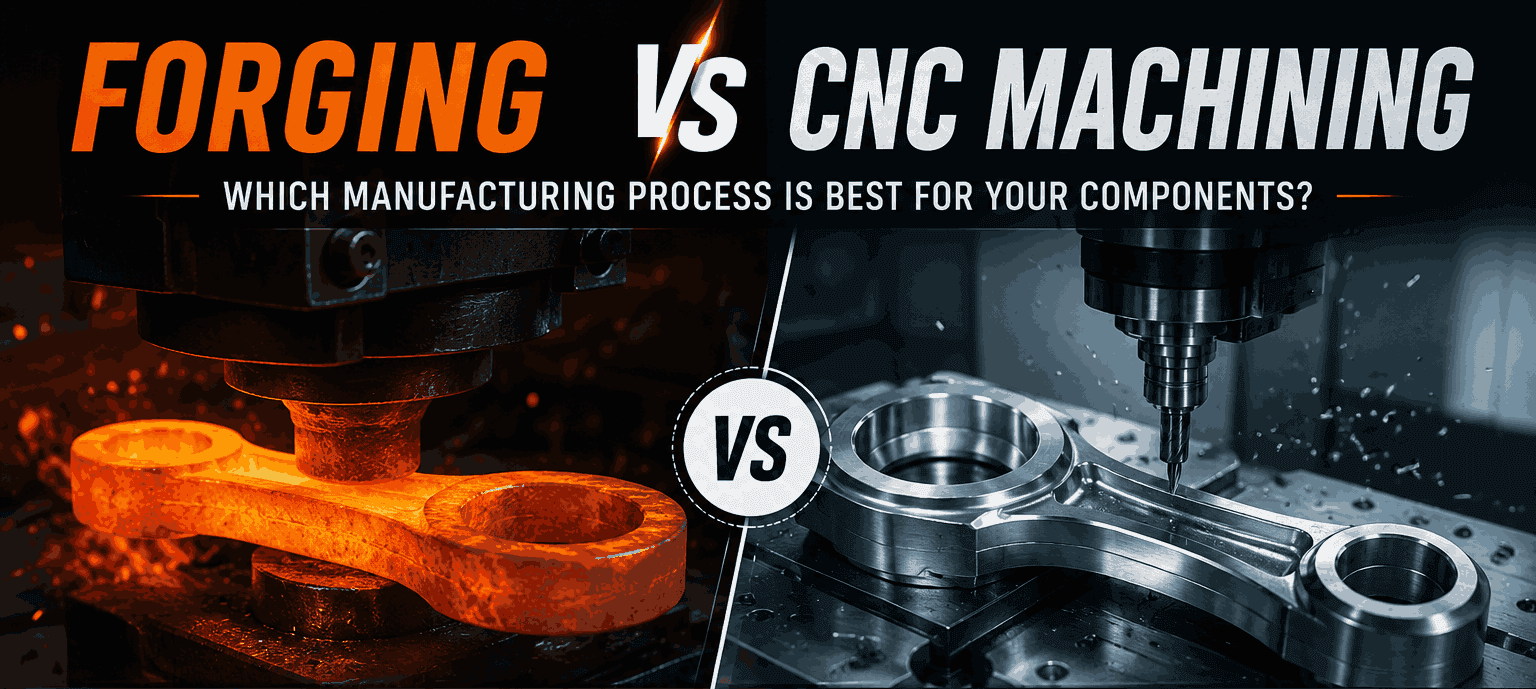
Forging is one of the most reliable manufacturing processes for producing high-strength metal components used across automotive, hydraulic, construction, agricultural, and heavy engineering industries. Among the various forging methods, closed die forging and open die forging are the two most widely used techniques. Choosing the right forging process is essential because it directly influences product quality, dimensional accuracy, manufacturing costs, and overall component performance.
Why Choosing the Right Forging Process Matters
Every industrial application has unique engineering requirements. Some components demand high precision and repeatability for mass production, while others require large dimensions, flexibility, and exceptional structural strength. Selecting the appropriate forging process ensures improved product quality, longer service life, reduced material waste, and greater manufacturing efficiency.
What is Closed Die Forging?
Closed die forging, also known as impression die forging, involves placing heated metal inside specially designed dies that completely enclose the workpiece. As pressure is applied, the metal flows into the die cavity, producing components with precise dimensions, excellent surface finish, and consistent quality. This process is ideal for manufacturing complex shapes in medium to high production volumes.
Advantages of Closed Die Forging
- Excellent dimensional accuracy and repeatability.
- Superior surface finish with minimal machining requirements.
- High mechanical strength and structural integrity.
- Reduced material waste and improved production efficiency.
- Ideal for medium and large-scale manufacturing.
- Suitable for complex component designs.
What is Open Die Forging?
Open die forging shapes heated metal between flat or simple dies without completely enclosing the material. The workpiece is gradually formed through repeated compressive forces, making this process suitable for manufacturing large components and custom-engineered parts. Open die forging offers greater flexibility for oversized products and lower production volumes.
Advantages of Open Die Forging
- Suitable for manufacturing very large components.
- Flexible process for customized dimensions and designs.
- Lower tooling investment compared to closed die forging.
- Excellent internal grain structure and mechanical strength.
- Ideal for prototype development and small production runs.
- Capable of producing heavy-duty industrial components.
Closed Die Forging vs Open Die Forging
- Dimensional Accuracy: Closed die forging provides excellent precision, while open die forging offers moderate accuracy suitable for larger components.
- Surface Finish: Closed die forged parts generally require little machining, whereas open die forged components often need additional finishing.
- Production Volume: Closed die forging is ideal for medium and high-volume production, while open die forging is better suited for low-volume or custom manufacturing.
- Material Waste: Closed die forging minimizes material waste, whereas open die forging may generate higher material usage depending on the application.
- Component Complexity: Closed die forging efficiently produces intricate and complex shapes, while open die forging is best for simpler, larger geometries.
Common Industrial Applications
Both forging methods are widely used across industries where component strength, durability, and reliability are critical.
- Automotive Industry
- Hydraulic Equipment Manufacturing
- Valve & Pump Industries
- Construction Equipment
- Agricultural Machinery
- Heavy Engineering
- Power Generation
- Industrial Machinery
Typical Forged Components
Common forged products include connecting rods, clutch parts, hydraulic valves, valve bodies, valve bonnet covers, seat rings, shafts, flanges, gears, forged forks, pump components, couplings, transmission parts, and customized engineering components designed for specialized industrial applications.
Which Forging Process Should You Choose?
Closed die forging is the preferred choice when high precision, excellent repeatability, superior surface finish, and large production volumes are required. It is widely used for automotive, hydraulic, and precision industrial components.
Open die forging is more suitable for oversized components, heavy engineering products, custom dimensions, and lower production quantities where flexibility and exceptional internal strength are the primary requirements.
Why Choose Avadh Techno Forge?
Avadh Techno Forge specializes in manufacturing premium-quality forged components using advanced forging technologies and rigorous quality control processes. Our experienced engineering team provides both standard and customized forging solutions tailored to meet the specific requirements of customers across automotive, hydraulic, agricultural, construction, industrial, and heavy engineering sectors.
With modern manufacturing facilities, competitive pricing, timely delivery, and an unwavering commitment to quality, we deliver reliable forging solutions that help businesses improve productivity, reduce operational costs, and achieve long-term performance.
Conclusion
Both closed die forging and open die forging offer unique advantages depending on the application, production volume, and design requirements. Understanding the differences between these processes allows manufacturers to select the most efficient and cost-effective solution for their projects.
Whether you require precision-engineered closed die forged components or customized open die forging solutions, Avadh Techno Forge has the expertise, technology, and manufacturing capabilities to deliver products that meet the highest standards of quality, strength, and reliability. Contact us today to discuss your forging requirements and discover the right solution for your business.